
The Quiet Creep: How Dog Trainers End Up Doing Everything and Burn Out
At some point, many dog trainers find themselves doing work they never really set out to do. Dog walking. Pet sitting. Drop-ins. Extra add-on services layered into already full days.
Not because it was the dream, or even part of the original plan, but because training alone didn’t feel financially stable. And so, slowly and quietly, more work gets added in an effort to make things feel safer.
This is something I see repeatedly in our industry, and it’s rarely talked about honestly. We often frame it as being flexible or diversifying, but underneath it’s usually something much simpler: survival.
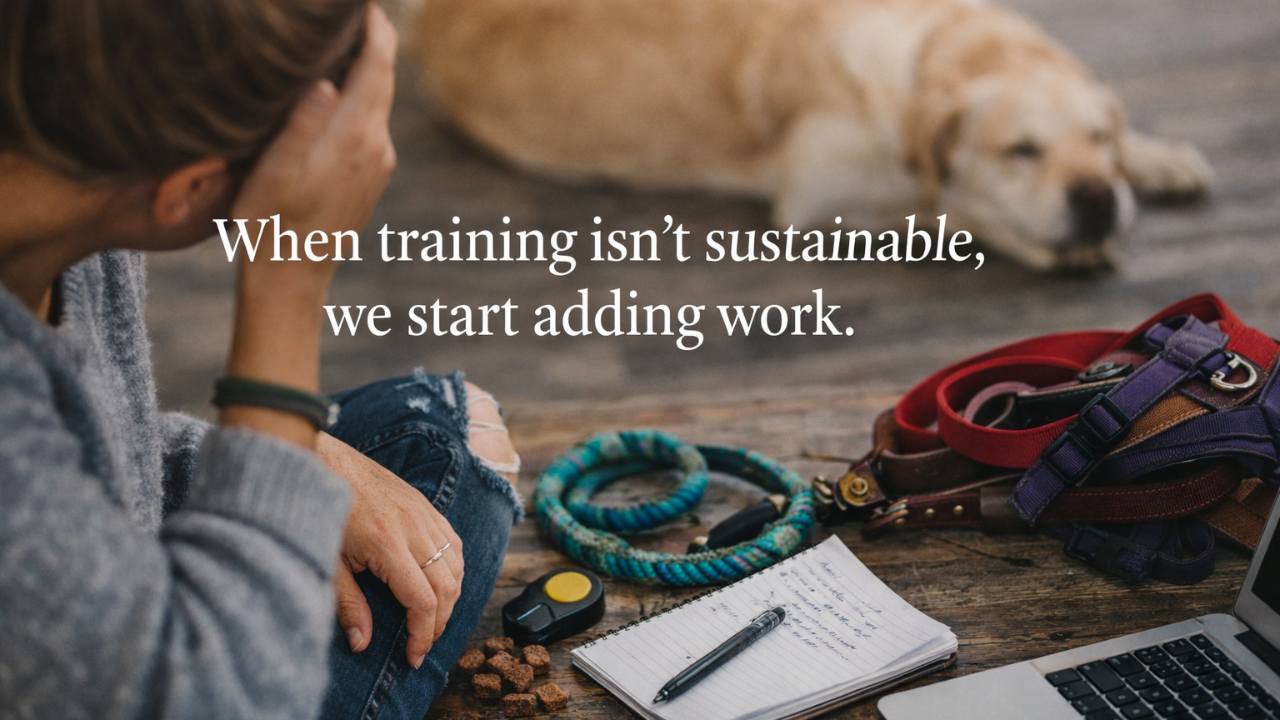
When training doesn’t feel sustainable on its own, we start adding work.
Reward-based dog training attracts people who care deeply. About dogs, about outcomes, about doing things ethically and thoughtfully. That level of care is a strength, but without the right structure, it can quietly become a trap. Many trainers don’t add services because they want to; they add them because they feel pressure to make things work, to say yes, to not disappoint clients, or to minimize the financial strain that comes with self-employment.
Over time, those lower-cost, time-heavy services can quietly pull trainers away from the work they’re actually skilled at, leaving them more tired and less fulfilled by the work they do. And when that happens, it’s easy to turn inward and assume the problem is personal - that you’re not cut out for business, or that you’ve somehow failed.
But in many cases, it’s not a personal shortcoming at all. It’s a structural one.
Most trainers are never given a sustainable model for building a training-focused business. Training is skilled, nuanced, emotionally demanding work, yet it’s often priced and structured like simple time-based labor. When expertise is sold purely by the hour, the only way to earn more becomes working more. Such as adding more clients, more services, more availability.
That isn’t growth. It’s a slow leak.
Add-on creep rarely happens all at once. It usually looks like:
- One extra service to fill a gap
- One accommodation to help a client
- One more offering to feel a bit more financially secure
Before long, trainers are working longer days, juggling more roles, and spending less time doing the work that originally felt meaningful. From the outside, it can look like success because of busy schedules, full calendars, and constant demand. On the inside, it often feels exhausting and unsustainable.
More work doesn’t always mean more stability. Often it results in less space to think clearly.
Training is not just time spent with a dog. It’s observation, analysis, decision-making, emotional regulation, and advocacy and often in complex and emotionally charged situations. When trainers are forced to rely on add-ons to survive, that expertise gets diluted, both in how it’s perceived by others and how it’s valued by the trainer themselves.
Reclaiming training as skilled work requires asking some uncomfortable but important questions. Questions like:
- What work actually uses my expertise?
- What drains my capacity the fastest?
- What am I doing to survive that doesn’t support the long term?
These aren’t easy questions, especially when you’re already tired. But they matter.
There is another way to build a career in dog training and one that doesn’t rely on constant expansion, over-giving, or exhaustion. Sustainability isn’t about doing more. It’s about designing work that aligns with your values, your capacity, and the life you want to live.
And wanting that doesn’t mean you care less about dogs. In many ways, it means the opposite. It means you want to keep doing this work well, ethically, and with integrity and for a long time.
If you’ve found yourself adding services you never planned to offer, feeling stretched thin, or quietly questioning how long you can keep going, you’re not alone. And you’re not failing.
Often, it’s not the person that needs fixing.
It’s the model that needs rethinking.
If this piece feels familiar, we’ll be exploring these ideas more deeply in Built to Last, a small, thoughtful workshop focused on building sustainable, values-aligned work in dog training.
